

Subscribe Now

Simply Enter Your Details To Find Out How
We Can Help Your Business


Ready to go on a Discovery?


To Book your Employee Metrics Lite session, please fill in the details below and we will be in contact.

Apply Now

Please fill up the fields below
Employee Matters Logo
Get in Touch Get in Touch (02) 8021 4206
  • HR Services
        • Outsourced HR
        • How We Work - HR
        • Employee Metrics - Data Diagnostics
        • Featured Industries:

        • Australian Startups
        • Finance, Insurance and FinTech
        • Featured Solutions:

        • HR Consulting
        • Workplace Training
        • HR Policies & Procedures
        • Employee Assistance Program (EAP)
        • Products and Packages

        • We deliver measurable results through great HR:

        • Hear What Our Clients Say
  • Recruitment Services
        • Outsourced Recruitment
        • Featured Solutions:

        • Tiered Recruitment Packages
        • Recruitment Partner Service (RPS)
        • Learn More:

        • Hiring Manager Training
        • Why Choose Us for Recruitment?
        • How We Work (RPS)

        • We’re not an agency, and our clients love that:

        • Hear What Our Clients Say
  • About Us
    • About Employee Matters
    • Meet the Team
    • What Our Clients Say
    • Referrals and Partnerships
    • Core Values and Vision
  • Resources
        • The Latest:

        • News and Media
        • Blog Articles
        • Videos and Webinars
        • Featured Content:

        • ER Legislation Resource Hub
        • e-Book: 7 ER Risks for Employers
        • Downloads and Knowledge Hub:

        • HR Forms & Checklists
        • 'Working From Home' Pack
        • HR & Recruitment FAQ’s
        • Book: "From Hire to Fire"
        • From the Archives:

        • 'Employees Matter' Podcast
  • Jobs
  • Contact Us

Flexibility and Returning to the Office

October 16, 2024
  • Natasha Hawker HR recruitment expert
    Written by Natasha Hawker
    Founder and Managing Director

    Natasha is a leading HR expert, entrepreneur, author and sought-after media commentator for outlets such as Sunrise (Channel 7), ABC Radio and The Australian Financial Review. Natasha co-founded Employee Matters in 2011 to help Australian businesses achieve success through their people.

As Australia emerges from the pandemic, many businesses are navigating the transition of their employees back to the office. One of the central themes in this shift is the growing demand for flexibility in how, where, and when work is performed. The Australian workforce, like much of the world, grew accustomed during the pandemic to the benefits of remote working. However, Australian legislation, particularly under the Fair Work Act, adds another layer of consideration when employers decide how to manage flexibility.

The Demand for Flexibility

The rise of hybrid work models reflects a global trend, but it is especially significant in Australia, where work-life balance is highly valued. Employees have shown a strong preference for flexible work arrangements, whether in the form of remote work, staggered hours, or part-time options. According to the Australian Bureau of Statistics, nearly 40% of Australian employees worked from home during the pandemic, and many want to continue working in a hybrid model.

This shift has had numerous positive outcomes. For employees, flexible work options promote better mental health, reduce commuting time, and offer a greater ability to balance personal and professional commitments. For businesses, this flexibility has been linked to increased productivity and higher employee retention.

Legislative Framework for Flexible Work Arrangements

Australia has a solid legislative framework that supports flexibility in the workplace. Under the Fair Work Act 2009, certain employees have a legal right to request flexible working arrangements. These rights are particularly significant for:

  • Pregnant employees
  • Parents of a child who is school aged or younger
  • Carers as defined in the Carer Recognition Act 2010
  • Employees with a disability
  • Workers aged 55 or older
  • Victims of domestic violence
  • are caring for or supporting an immediate family or household member who requires care or support because they are experiencing family and domestic violence.

Employers are legally obliged to consider these requests and can only refuse on ‘reasonable business grounds.’ These grounds must be based on factors such as the cost to the business, the impact on productivity, or the inability to reorganise work among existing staff.

This legal context means that when planning a return to the office, Australian employers must take these considerations seriously. Refusing a flexible work request without sufficient justification could lead to legal challenges.

Some examples of changes in working arrangements could include: 

  • Flexibility around start and finish times and hours of work
  • Changes in patterns of work such as job sharing
  • Changes in work location such as working from home or another location

Balancing Flexibility with Business Needs

While flexibility is desirable for employees, many businesses have reasons for wanting staff to return to the office, at least part-time. Reasons include fostering team collaboration, enhancing company culture, and ensuring adequate supervision of tasks that may not be suitable for remote work.  On the other hand, there are benefits to taking a flexible approach to remote working that can include improvements in productivity, boosted employee morale, improved retention rates, and a competitive edge in a crowded employer market.

The key is striking a balance between flexibility and operational requirements. Some organisations are adopting hybrid work models, where employees split their time between the office and remote locations. This approach enables employers to maintain a sense of team cohesion while offering employees some control over their working environment.

How Australian Businesses Can Approach Flexibility

  1. Review Current Policies: Businesses should review their current workplace policies to ensure they align with the Fair Work Act. This includes making sure there is a clear process for handling flexible work requests.
  2. Consultation and Communication: Open dialogue with employees is essential. Many companies have found success by directly consulting workers about their preferences and needs. This fosters trust and collaboration when designing a return-to-office plan.
  3. Trial Periods for Hybrid Models: Some businesses are introducing trial periods for hybrid work models, giving both employers and employees time to assess what works best. During these trials, companies can evaluate productivity levels, collaboration, and any logistical issues.
  4. Workplace Wellbeing Initiatives: To support workers returning to the office, many businesses are adopting initiatives to prioritise well-being. Offering mental health support, ergonomic office spaces, and flexible start times can help ease the transition.
  5. Embrace Technology: The pandemic accelerated digital transformation across many industries, and embracing technology continues to be crucial. Tools like cloud-based platforms, video conferencing, and collaboration software can support flexible work arrangements and make remote work more efficient and help remote workers to feel more connected to their team.

The Future of Work in Australia

As Australia adapts to post-pandemic realities, the demand for flexibility in the workplace is unlikely to fade. Employees have tasted the benefits, and with legal frameworks to back them up, flexibility will likely remain a prominent feature of work in the coming years. For Australian businesses, the challenge lies in creating work environments that balance flexibility with productivity and business success.

The ongoing evolution of workplace laws and the Fair Work Act may also see further support for flexible arrangements, particularly as the Federal Government continues to review employment policies in response to changing work patterns.

In summary, returning to the office in Australia isn't simply a matter of reopening doors; it’s about rethinking work structures to cater to the evolving needs of a post-pandemic workforce. Flexibility, supported by Australian legislation, will be a key driver in shaping the future of work. This balanced approach will not only protect businesses from potential legal challenges but will also position them as forward-thinking employers in a competitive talent market.

For more information on you can sustainability adopt flexibility in your organisation, contact us now to request a consultation on the way forward.


Australian Employee Relations Legislation Resource Hub

There is a significant amount of mandatory Employment Relations legislative change that impacts you and every other business in Australia now. Our resource hub is designed to help you understand these wide-ranging changes.

Access It Here

Fair Work Legislation Amendment (Closing Loopholes) Act

Access this concise Closing Loopholes Bill summary and guide detailing the proposed changes to the Fair Work Act, and the implications for employers:
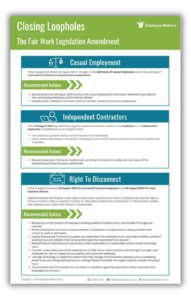

Infographic Closing Loopholes

Get in Touch

Tell us a bit about your business and we’ll be in touch to:

  • Understand the challenges that are holding your team or growth back
  • Show you how our embedded HR and Recruitment Experts can solve problems faster, without the overheads
  • Identify high-impact areas where HR and Recruitment support could save you time, stress, and money
  • Map out a tailored approach based on your goals, industry, and internal capabilities

Alternatively, you can call us on (02) 8021 4206.
Tags: Employee management, Flexible working
Contents
The Demand for Flexibility
Legislative Framework for Flexible Work Arrangements
Balancing Flexibility with Business Needs
How Australian Businesses Can Approach Flexibility
The Future of Work in Australia
Get in Touch

Latest News and Media

HR workplace update February 2026

Job Search 2026: The Power of Personality in the Age of AI

  • 11 February 2026
The job market has changed. If you’re applying for roles in 2026, you’re not just trying to impress a hiring manager, you’re trying to get past AI. Learn more in...
Read More
Howse Rivers partnership

The Making of a CEO: Strategies for Success – Howse & Rivers

  • 12 September 2025
In a recent conversation with Adelle Howse from Howse & Rivers, Natasha Hawker shared the journey of starting and growing Employee Matters. While many see an "overnight success," the reality...
Read More
Simple Scaling ScaleX Insider podcast

Building Stronger Businesses Through People: Natasha Hawker on the ScaleX Insider Podcast

  • 12 August 2025
“You don’t build a business — you build people and people build the business.” This was the central theme when Natasha Hawker, Founder of Employee Matters and leading expert in...
Read More
Hot desking workplace etiquette

Experts Weigh In on Correct Hot-Desking Etiquette

  • 22 July 2025
Hot-desking is now common in many Australian workplaces, but not everyone knows the best way to share a desk. Natasha Hawker, managing director of HR and recruitment firm, Employee Matters,...
Read More
Sunrise TV workplace discussion

The Sick Tax: How to Tackle Presenteeism in Your Workplace

  • 3 June 2025
The Sick Tax in Australian Workplaces and Why ‘Presenteeism’ Is Costing Businesses Billions If you’ve ever felt guilty about calling in sick, you’re not alone. Natasha Hawker, founder of Employee...
Read More
Sunrise TV interview May 2025

High Paying Jobs You DON’T Need A Degree For

  • 20 May 2025
A university degree has long been seen as the primary path to a high salary, but with the evolving job market, many Australians are discovering alternative routes to rewarding careers....
Read More
Speak up about workplace misconduct

Should You Speak Up if You See Bad Behaviour at Work?

  • 6 May 2025
Speaking Up at Work: What Should You Do When You Witness Unethical Behaviour? Workplace conflict is inevitable, but how it’s managed—or ignored—can make all the difference to employee wellbeing, team...
Read More
Office promotion policy divides Aussie workers

Tactic linking promotions to being in office completely divides Aussie workers

  • 27 April 2025
Promotions Now Tied to Office Attendance? The Return-to-Office Push Divides Aussie Workers A growing number of Australian employers are finding new ways to encourage staff back into the office —...
Read More

Latest Blog Articles

The Redundancy Ripple Effect: Why Unfair Dismissal Claims are Skyrocketing

  • 24 March 2026
In the current Australian economic climate, business as usual feels like a distant memory. As the cost of doing business climbs and the Reserve Bank continues to adjust interest rates,...
Read More

Beyond the Request: Victoria’s New Era of Right to WFH

  • 16 March 2026
The conversation around flexible work in Australia is shifting from asking for a favour to exercising a legal right. While recent Fair Work Commission rulings like Fitzpatrick v UNSW and...
Read More

A Tale of Two WFH Requests

  • 16 March 2026
Recent rulings in the Fair Work Commission have provided a critical wakeup call for both employees and HR professionals. Two landmark cases from 2025 and 2026 (Fitzpatrick v University of...
Read More

Leading the Way: Sentius Implements Groundbreaking Menstrual and Menopause Policy

  • 9 March 2026
At Employee Matters, we are incredibly proud to partner with clients who don't just talk about workplace culture but actively build it. Today, we are celebrating a major milestone with...
Read More
Workplace misconduct policy guide

Why Every Business Needs a Clear Misconduct Policy

  • 26 February 2026
At Employee Matters, we spend a lot of time supporting businesses through difficult conversations. In many cases, those conversations start the same way: “We didn’t think we’d ever need a...
Read More
Workplace HR update February 2026

Personality is Your Superpower in the Age of AI

  • 24 February 2026
We are living in a new era of recruitment. With over 90% of Australian bosses now using Artificial Intelligence to advertise and hire, the landscape for job seekers has fundamentally...
Read More
Benefits of outsourced HR services

How Outsourced HR Services Can Save You Time, Money and Stress

  • 24 February 2026
Most business owners don’t start a company because they’re passionate about employment contracts, performance plans, or award interpretations. Yet, before long, HR becomes a regular part of the working week....
Read More
HR blog header banner

Scrolling to Success: How to Recruit and Retain Generation Z

  • 16 February 2026
The Australian workforce is undergoing a seismic shift. As Baby Boomers retire and Millennials move into senior leadership, a new force has risen: Generation Z. Born between 1997 and 2012,...
Read More

(02) 8021 4206
  • About Us
    • About Employee Matters
    • Book a Free Call
    • What Our Clients Say
  • Services
    • Outsourced HR Services
    • Outsourced Recruitment
    • Recruitment Partner Service (RPS)
  • Resources
    • News and Media
    • Forms & Checklists
    • Blog
  • News and Media
  • Blog
  • Contact Us

Employee Matters helps businesses in Sydney, Melbourne, Perth, Brisbane, and across all major Australian towns and cities with their HR and Recruitment needs.

Copyright | Employee Matters
Terms + Conditions | Privacy Policy
Design by Five by Five
Winning the War for Talent

Hiring is harder than ever. Finding great talent is the #1 challenge for business owners. Stop reactive hiring and start winning the war for talent with this practical 15-step recruitment guide.


Workplace and Management Training & Coaching Services

Our specialised training programs are meticulously crafted to meet the unique needs of your workforce, helping them excel in their roles so they can drive your success.


E-book: Winning the War for Talent

Enter your details below and start building a recruitment strategy that actually works — even in today’s challenging talent market


Are You Fully Across the New Employment Relation Changes?

Make compliance simple with our practical checklist outlining the essential implementation steps every employer must address:


Sample Exit Interview Template

Make your offboarding process smoother and more effective with our ready-to-use Exit Interview Template. Enter your details to download:


4 Steps to Managing Psychosocial Hazards and Risks

Protect your workplace from psychosocial risks. Access our 4-step guide by entering your details below:


Download Infographic: Workplace Sexual Harassment is Bad for Business

Workplace sexual harassment isn’t just a moral issue—it’s a costly business risk. Enter your details below to see the evidence behind its financial and organisational impact:


Working From Home Pack

The pack includes:

  • Comprehensive Employer Guide to Employees Working From Home
  • Comprehensive Employee Guide to Working From Home
  • Working From Home Policy
  • WH&S Working From Home Audit Checklist

Fill out the form below to access it.


Assess Your HR & Recruitment Practices

This self-assessment checklist helps you evaluate your current HR and recruitment practices and kickstart internal conversations about your future strategy. Fill out the form below to access it.


Psychosocial Hazards in the Workplace – The Facts You Need to Know

See why psychosocial hazards are among the fastest-growing challenges for employers. Enter your details below to access a snapshot of their rising financial and human impact in Australian workplaces.:


Get In Touch

Call us on (02) 8021 4206 or use the form below to tell us about your requirements and we’ll be in touch to guide you on which Employee Matters services are best for you:


Book a Free Call

We’re Here to Help!

Call us on 02 8021 4206 – email info@employeematters.com.au – or complete the form below to book a time that suits you:


HR Kickstart


What Matters

Subscribe to our newsletter ‘What Matters’ to stay up to date with all the latest news, useful downloadable assets and exclusive offers: