


-
Founder and Managing DirectorNatasha is a leading HR expert, entrepreneur, author and sought-after media commentator for outlets such as Sunrise (Channel 7), ABC Radio and The Australian Financial Review. Natasha co-founded Employee Matters in 2011 to help Australian businesses achieve success through their people.
Recent rulings in the Fair Work Commission have provided a critical wakeup call for both employees and HR professionals. Two landmark cases from 2025 and 2026 (Fitzpatrick v University of New South Wales and Chandler v Westpac Banking Corporation) clarify that while the right to request is expanding, it is not a free pass for every lifestyle preference.
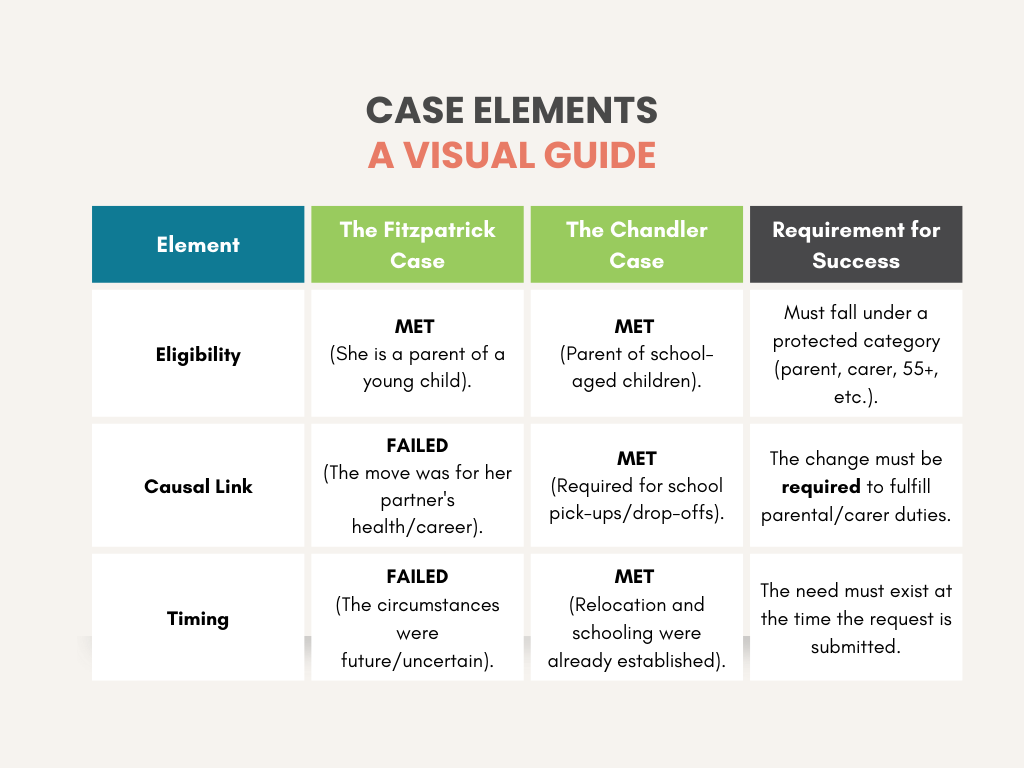
To succeed, there must be a direct, causal link between parenting duties and the specific change being asked for.
The Core Conflict: Preference vs. Necessity
In Fitzpatrick v UNSW, an employee sought to move interstate to support her partner's career and mental health. While these were relatable life choices, the Commission drew a sharp line: personal preference does not equal parental necessity.
Conversely, in Chandler v Westpac, an employee successfully argued for full-time remote work after moving house and enrolling her children in a distant school. Although her relocation was a life choice, her husband’s inability to work remotely meant she was solely responsible for school transit, creating a concrete parental requirement.
Free Download:
Working From Home Pack
These resources will help your team stay productive, focused, and supported while working remotely

Why Requests Fail: The Fitzpatrick Breakdown
Commissioner Sarah McKinnon’s ruling in Fitzpatrick highlighted three specific reasons the request fell short of the legal threshold under Section 65 of the Fair Work Act:
- The "Because Of" Test: The Act requires a request to be made because of the employee's circumstances (e.g., being a parent). Fitzpatrick’s request was actually driven by her partner’s career and family finances.
- The Tenuous Connection: The employee was already managing her parenting duties successfully via a hybrid arrangement in Sydney. Moving was a choice, not a requirement of her parenting status.
- The "Puzzle" Problem: You cannot request flexibility for circumstances that do not yet exist. At the time of the request, Fitzpatrick’s move was hypothetical, with no confirmed childcare or location.
“[The employee] wants, but is not required, to move to Queensland to support her partner's health and career while also improving the family's financial position. Her reasons are understandable, but they are not circumstances of the kind that engage the right to request under s.65.” Commissioner Sarah McKinnon
Why Requests Succeed: The Chandler Counterpoint
In Chandler v Westpac, the Commission ordered the employer to grant remote work despite the employee's "life choices". The deciding factors were:
- Proven Performance: The employee had worked remotely since 2018 with high productivity.
- Weak Employer Evidence: Westpac relied on generalised benefits of office culture (like team huddles) that the Commission found could be done via Teams, Zoom etc.
- Severe Prejudice: The minimal benefit of office attendance was outweighed by the "seriously prejudicial" impact on the employee’s ability to care for her children.

Lessons for Employers:
- Individual Cases require an Individual Approach - While many requests for Flexible Working will have similar justifications, each case must be looked at in terms of the specific circumstances. The days of a general pro forma reply to flexible work requests are gone (if they ever really existed).
- Process Matters - A win can easily turn into a loss if procedural requirements aren't met. In the Chandler case, Westpac breached Section 65A by failing to respond within 21 days and providing only cursory reasons for refusal.
The Bottom Line
Parenting status (or any other of the range of statutory recognised reasons) is not a blanket entitlement to remote work. If a request is based on preference rather than a concrete requirement, the Commission may lean toward the employer.
However, if the employee can prove a necessity and the employer does not genuinely engage to find a solution or show why the request cannot reasonably be met in this circumstance, then the request may be enforced.
Please Note: being general information pertaining to the field of human resources management, the information in this blog article does not constitute specific legal advice and should not be relied upon as such. Employee Matters is not a legal firm and does not purport to give legal advice. We will happily provide you with general legal information on employment related topics and if we feel you need specific legal advice, we will inform you of this and can refer you to independent specialist employment law firms, as necessary.
Need some help with a complex flexible work request? Individual circumstances require an individual approach. If you are currently weighing a request and want to ensure you meet your Section 65A obligations, let’s talk.
Get in Touch
Tell us a bit about your business and we’ll be in touch to:
- Understand the challenges that are holding your team or growth back
- Show you how our embedded HR and Recruitment Experts can solve problems faster, without the overheads
- Identify high-impact areas where HR and Recruitment support could save you time, stress, and money
- Map out a tailored approach based on your goals, industry, and internal capabilities
Alternatively, you can call us on (02) 8021 4206.

