

Founder and Managing DirectorNatasha is a leading HR expert, entrepreneur, author and sought-after media commentator for outlets such as Sunrise (Channel 7), ABC Radio and The Australian Financial Review. Natasha co-founded Employee Matters in 2011 to help Australian businesses achieve success through their people.
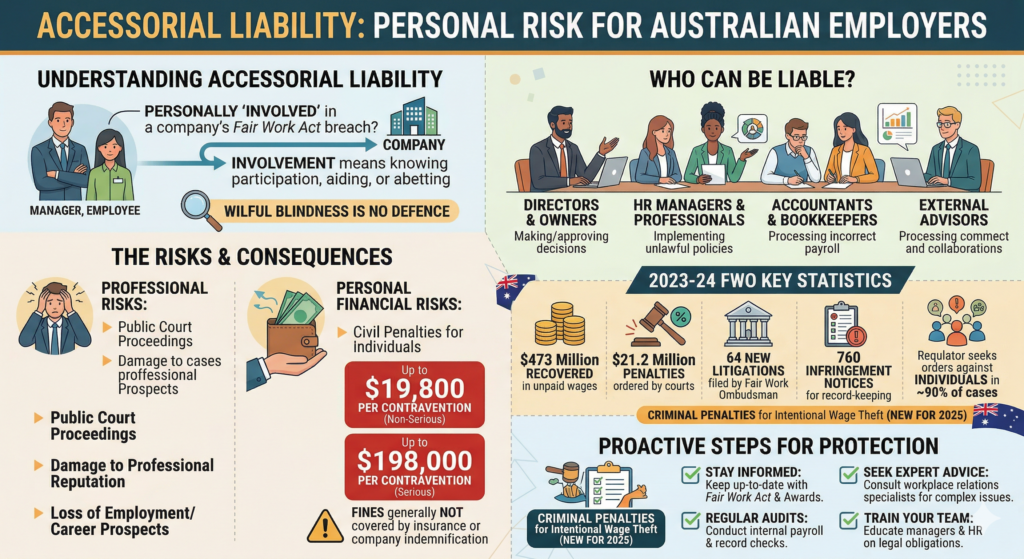
In Australian employment law, the "corporate veil" provides little protection for professionals. Under Section 550 of the Fair Work Act 2009, individuals can be held personally liable for company breaches. If you are "involved" in a contravention, the law treats you as if you committed the breach yourself.
The Scope of Risk
Liability isn't restricted to CEOs. It extends to HR Managers, Payroll Officers, Accountants and Directors. You are legally "involved" if you aid, abet, counsel or are simply "knowingly concerned" in a breach, even through inaction.
- Financial Exposure: Penalties can reach $19,800 per contravention, or $198,000 for serious breaches. These are typically uninsurable and cannot be indemnified by your employer.
- Professional Reputation: The Fair Work Ombudsman (FWO) increasingly names individuals in public proceedings. These records are permanent and searchable.
The Reality of "Knowledge"
"Just following orders" is not a valid legal defence. If you have "actual knowledge" of the facts making a practice unlawful, or if you deliberately turn a blind eye, courts can find you liable. Ignorance is rarely a shield for professionals expected to understand workplace standards.
Accessorial Liability: Personal Risk for Australian Employers

Strategic Protection: 5 Essential Steps
- Maintain Professional Skepticism Never assume payroll systems or historical practices are compliant. Periodically audit payroll outputs against the National Employment Standards (NES) and relevant Modern Awards to ensure correct classifications and loadings.
- Intervene and Escalate If you identify an underpayment or a "sham" contracting arrangement, raise it promptly in writing. Delaying action or staying silent increases your personal legal exposure.
- Document Your Position When you provide advice or raise concerns about compliance, ensure there is a clear paper trail. This documentation is critical evidence should your involvement ever be scrutinised by a court.
- Refuse Unlawful Directions If directed to implement a practice you know is non-compliant (e.g., falsifying records or ignoring overtime), do not proceed. Seek independent advice and escalate the issue to senior leadership or the board.
- Treat Compliance as Ongoing Laws and Awards change frequently. Ongoing training and regular audits are necessary to prevent "compliance drift," where small errors compound into massive, multi-million dollar liabilities over time.
The Critical Takeaway: The Fair Work Ombudsman is no longer just looking at the company checkbook; they are looking at the individuals who allowed the breach to happen. Compliance is your personal responsibility.
Employee Matters works with businesses and leadership teams to identify compliance risks early, implement practical solutions and ensure workplace practices are robust, defensible and aligned with legal obligations.
Get in Touch
Tell us a bit about your business and we’ll be in touch to:
- Understand the challenges that are holding your team or growth back
- Show you how our embedded HR and Recruitment Experts can solve problems faster, without the overheads
- Identify high-impact areas where HR and Recruitment support could save you time, stress, and money
- Map out a tailored approach based on your goals, industry, and internal capabilities
Alternatively, you can call us on (02) 8021 4206.

