Natasha is a leading HR expert, entrepreneur, author and sought-after media commentator for outlets such as Sunrise (Channel 7), ABC Radio and The Australian Financial Review. Natasha co-founded Employee Matters in 2011 to help Australian businesses achieve success through their people.
In any thriving organisation, maintaining high standards of conduct and behaviour is crucial for maintaining order, fostering employee growth, and safeguarding the interests of the organisation. A well-crafted Code of Conduct and a clear Misconduct and Disciplinary Action policy not only sets clear expectations but also ensures fairness and consistency in addressing issues related to misconduct and breaches of the law or company policies.
Free Download:
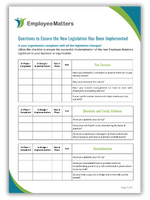
Your Employee Relations Legislation Implementation Checklist
Quickly assess if your business is meeting the latest Fair Work requirements with our ready-to-use checklist
In this blog article, we cover 5 key components for creating successful workplace disciplinary action policies & procedures:
Establishing Clear Objectives
Through a robust disciplinary policy, Employees are guaranteed fair treatment during disciplinary proceedings which follow legal requirements and principles of Natural Justice. The disciplinary policy outlines counselling and disciplinary methods for addressing unsatisfactory behaviour. It helps managers clearly communicate concerns and encourages improvement. The process ensures fairness, confidentiality, and support for employees to improve, except in cases of serious misconduct where appropriate actions are taken immediately.
Responsibilities
While senior leaders hold overall responsibility for staff direction, the day-to-day performance and behaviour of employees within a department or team are usually the responsibility of the direct manager. If informal measures prove ineffective, a formal process may be initiated, possibly involving higher management. The senior leader may delegate the disciplinary process to other managers as appropriate.
Investigation Process
When misconduct is alleged, the disciplinary policy will allow for investigations to take place as the facts will need to be established. Often the facts are clear but if there is any uncertainty then an investigation will be needed.
If an investigation is required, the senior leader can ask the workplace manager for written details and evidence of the allegations and appoint someone to investigate. This could be a manager, a representative from Human Resources or an external investigator if the matter is particularly sensitive or serious.
The investigator will interview relevant people and seek written statements. This will involve ensuring that the employee concerned has the opportunity to understand and respond to the allegations of misconduct made against them. The investigator will then report on the findings and whether on the balance of probabilities, the allegations of misconduct are substantiated i.e. if they occurred.
Formal Disciplinary Hearing
Where misconduct has taken place and formal disciplinary action may be taken, a formal hearing must be held.
It is important that the process for this is fair and reasonable, which means:
Giving the employee reasonable notice of the hearing (24 hours is the absolute minimum).
Giving the employee the opportunity if they wish to have a support person present in the hearing.
Ensuring the employee is clearly told the nature of the misconduct allegation.
Ensuring the employee has the opportunity to respond to the allegations and to set out reasons or mitigating circumstances for their actions.
Ensuring the employee’s response is considered and taken into account before a final decision is made.
Ensuring any disciplinary action taken is within the policy, is reasonable, and is lawful, especially if the action involves terminating the employee’s employment.
Documentation
Thorough documentation is pivotal throughout the disciplinary process. Managers must maintain file notes for all discussions with the employee, the investigator must have notes and statements from everyone who takes part, and formal disciplinary action must be confirmed in writing.
From Gap to Gold Standard: Barrelhouse’s Success in Creating a Safer Workplace
As part of an audit of compliance with the latest Respect@Work legislation, Safe Work NSW conducted an audit across the hospitality industry in the Sydney CBD. A Barrelhouse Group venue was audited and gaps were identified in compliance with the latest Respect@Work legislation. The audit of hospitality businesses in Sydney’s CBD was prompted when allegations of sexual harassment with a competitor group surfaced. Barrelhouse Group wanted to address the issue head on and worked with Employee Matters as experts in this area.
Creating clear Workplace Misconduct and Disciplinary Action policies & procedures, which everyone understands and follows when dealing with conduct issues, together with your written Code of Conduct, will give you the basis for dealing with any alleged misconduct in a way that is fair, reasonable and lawful.
If you need help with a misconduct/disciplinary issue, and would like to speak with an experienced member of our team to learn how we can support you with the matter, please use the button below to book a free call. We also assist organisations with creating and updating their Misconduct and Disciplinary Action policies & procedures — if you don’t have one or yours is not up-to-date, enquire below to ensure you’re not caught out should employee misconduct occur.
Get in Touch
Tell us a bit about your business and we’ll be in touch to:
Understand the challenges that are holding your team or growth back
Show you how our embedded HR and Recruitment Experts can solve problems faster, without the overheads
Identify high-impact areas where HR and Recruitment support could save you time, stress, and money
Map out a tailored approach based on your goals, industry, and internal capabilities
Call us on (02) 8021 4206 or use the form below to tell us about your requirements and we’ll be in touch to guide you on which Employee Matters services are best for you: