 Founder and Managing Director
Natasha is a leading HR expert, entrepreneur, author and sought-after media commentator for outlets such as Sunrise (Channel 7), ABC Radio and The Australian Financial Review. Natasha co-founded Employee Matters in 2011 to help Australian businesses achieve success through their people.
In February 2023, the Australian Government took a decisive step towards addressing the gender pay gap with the introduction of the Workplace Gender Equality Amendment (Closing the Gender Pay Gap) Bill 2023. From this year, the findings are public, which means that companies will effectively be ‘named and shamed’ in the court of public opinion. A few high profile cases from this year's results such as Pandora (47.2% gap) and Seafolly (44.5% gap) raised eyebrows given that their customer bases are overwhelmingly women. There have of course been some good news stories with a significant number of businesses having a zero% difference, but the overwhelming majority have reported that women are paid less overall.
Some Key Highlights:
- Legislation Overview:
- Passed in March 2023, this bill mandates employers with 100 or more employees to annually disclose their gender pay gap data, enhancing transparency and accountability in promoting gender equality.
- Compliance Requirements:
- Starting from 27 February 2024, private sector companies with 100 or more employees must submit their gender pay gap data to the Workplace Gender Equality Agency (WGEA). This data will be publicly accessible on the WGEA website (employers will be given an opportunity to provide a statement that gives context to their gender pay gap results or outlines their plans for actions).
- Public sector employers will follow suit by late 2024 or early 2025.
- The reporting period for this year beings on 1 April 2024, with Australian employers mandated to submit more comprehensive data which includes
- The year of birth of each employee
- The primary location of the workplace; and
- Remuneration information for CEOs, Business Heads, and casual managers.
- Enhanced obligations for reporting on prevention and response to sexual harassment, harassment on the ground of sex or discrimination in the workplace.
- The new legislation requires employers to provide their WGEA Executive Summary and Industry Benchmark Report to their Board.
- Organisations employing 500 or more individuals will be required to have policies or strategies for each of the six gender equality indicators (gender composition of the workforce and governing bodies; equal pay between genders; employment terms and practices that support flexible working arrangements and assist employees with family or caregiving responsibilities; engaging employees in discussions about workplace gender equality; and sexual harassment, and sex-based harassment and discrimination).
Implications of Non-Compliance:
The Workplace Gender Equality Agency (WGEA) will list non-compliant organisations publicly, highlighting those who fail to meet their reporting obligations or the minimum standards for demonstrating a commitment to gender equality.
- WGEA can name an employer in a report to the Minister that is tabled in both Houses of Parliament and could be subject to media coverage, spotlighting their failure to uphold gender equality standards.
- WGEA can name an employer publicly by electronic or other means.
- An employer may not be eligible to tender for contracts under Commonwealth and some state procurement frameworks and may not be eligible for some Commonwealth grants or other financial help.
Key dates:
- The Gender Equality Reporting program will be open for submission each year for 2 months from April 1st to May 31st. Organisations must submit their report and resolve any data quality issues before the deadline.
- Data being submitted for the Gender Equality Reporting program will be in respect to the 12 months from 1 April of the prior year to 31 March of the current year.
Next Steps:
- Visit the WGEA's official reporting guide, and register your organisation.
- Prepare and submit your gender pay gap data in alignment with the specified deadlines. and follow the process for reporting.

Australian Employee Relations Legislation Resource Hub
There is a significant amount of mandatory Employment Relations legislative change that impacts you and every other business in Australia now. Our resource hub is designed to help you understand these wide-ranging changes.
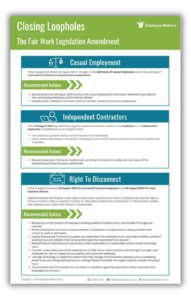
Fair Work Legislation Amendment (Closing Loopholes) Act
Access this concise Closing Loopholes Bill summary and guide detailing the proposed changes to the Fair Work Act, and the implications for employers:
Get in Touch
Tell us a bit about your business and we’ll be in touch to:
- Understand the challenges that are holding your team or growth back
- Show you how our embedded HR and Recruitment Experts can solve problems faster, without the overheads
- Identify high-impact areas where HR and Recruitment support could save you time, stress, and money
- Map out a tailored approach based on your goals, industry, and internal capabilities
Alternatively, you can call us on (02) 8021 4206.