Subscribe Now

Simply Enter Your Details To Find Out How
We Can Help Your Business


Ready to go on a Discovery?


To Book your Employee Metrics Lite session, please fill in the details below and we will be in contact.

Apply Now

Please fill up the fields below
Employee Matters Logo
Get in Touch Get in Touch (02) 8021 4206
  • HR Services
        • Outsourced HR
        • How We Work - HR
        • Employee Metrics - Data Diagnostics
        • Featured Industries:

        • Australian Startups
        • Finance, Insurance and FinTech
        • Featured Solutions:

        • HR Consulting
        • Workplace Training
        • HR Policies & Procedures
        • Employee Assistance Program (EAP)
        • Products and Packages

        • We deliver measurable results through great HR:

        • Hear What Our Clients Say
  • HRIS
    • EmployeeHub – Managed HRIS (HR Information System)
  • Recruitment Services
        • Outsourced Recruitment
        • Featured Solutions:

        • Tiered Recruitment Packages
        • Recruitment Partner Service (RPS)
        • Learn More:

        • Hiring Manager Training
        • Why Choose Us for Recruitment?
        • How We Work (RPS)

        • We’re not an agency, and our clients love that:

        • Hear What Our Clients Say
  • About Us
    • About Employee Matters
    • Meet the Team
    • What Our Clients Say
    • Referrals and Partnerships
    • Core Values and Vision
  • Resources
        • The Latest:

        • News and Media
        • Blog Articles
        • Videos and Webinars
        • Featured Content:

        • ER Legislation Resource Hub
        • e-Book: 7 ER Risks for Employers
        • Downloads and Knowledge Hub:

        • HR Forms & Checklists
        • 'Working From Home' Pack
        • HR & Recruitment FAQ’s
        • Book: "From Hire to Fire"
        • From the Archives:

        • 'Employees Matter' Podcast
  • Jobs
  • Contact Us

Implementing Employer-Paid Parental Leave Policies

Home » Implementing Employer-Paid Parental Leave Policies

May 1, 2024
  • Natasha Hawker HR recruitment expert
    Written by Natasha Hawker
    Founder and Managing Director

    Natasha is a leading HR expert, entrepreneur, author and sought-after media commentator for outlets such as Sunrise (Channel 7), ABC Radio and The Australian Financial Review. Natasha co-founded Employee Matters in 2011 to help Australian businesses achieve success through their people.

Where does Australia rank in terms of Paid Parental Leave?

It is fair to say that when it comes to Paid Parental Leave (PPL), Australia was late to the party. Before the first scheme was introduced in 2011, Australia was one of only 2 OECD countries who did not have such a scheme. Even now, many would suggest that our paid parental leave scheme lags behind many similar economies [1] (with the notable exception of the USA).

However, things are changing, albeit not as fast as many would like. The schedule to commence lifting the length of the government scheme is underway [2]. From 18 weeks paid leave prior to 1 July 2023, the length of PPL is increasing by 10 days (2 weeks) per year until it reaches 26 weeks from 1 July 2026. There is also much greater flexibility being introduced around who can take parental leave and who will be paid for it.

There is a ‘But’ however; the level of PPL in Australia is tied to the National Minimum Wage rather than the employee’s actual wage. Many of our OECD colleagues have at least some elements of PPL that are tied to actual wages or at least average wages rather than minimum wage.

So with this in mind, there are moves for employers to ‘top up’ the government PPL scheme with their own payments.

Are Employees being Offered Employer-Paid Parental Leave?

The Workplace Gender Equality Agency (WGEA) in its annual scorecard reports 63% of employers in their survey are offering some sort of employer-paid parental leave in addition to the government PPL scheme (up 1% from the previous year). Remember however, the WGEA figures are based on their survey, which is only compulsory for businesses with 100+ employees. Nevertheless there is a move to offer such schemes, so the obvious question is why?

Why Offer Employer-Paid Parental Leave?

In our talent-scarce employment environment, everything that encourages talented people to remain in the workforce with their current employer is an obvious win. Your Employee Value Proposition (EVP) is key not only to attracting the best talent in the market but also retaining your key talent; anything that does this must be worth considering.

Referring again to the OECD comparisons, we can see the difference a good scheme can make. Comparing Sweden and USA (which have similar birth rates), the percentage of women working in those countries represents a stark difference. Sweden with its generous PPL schemes has a female employment rate of 82%, whereas the USA only has a 69% female employment rate.

Nor is this all about mothers. The flexibility being introduced for taking government PPL which does away with ‘Dad and Partner’ pay in favour of a shared pool of PPL will hopefully see many more men taking time as a primary carer to support and bond with their children, rather than the current level of only 14%.

What should You Offer in Terms of Employer-Paid Parental Leave?

So you have seen the benefits of offering employer-paid parental leave - what next?

Here are some things to consider:

  • Length of pay?
    • Should this be the same at the government scheme and if so:
      • Will you increase it in line with the government scheme?
      • Will you introduce your scheme now at the 2026 limit of 26 weeks?
  • Amount of pay?
    • Will you pay the employee their normal pay in addition to the government scheme?
    • Will you pay the same as the government rate (i.e. the national minimum wage)?
    • Will you top up the difference between the government PPL and normal pay for the employee?
  • Pay options
    • Are there options for how employer-paid parental leave will be taken? e.g.
      • Agreed period at your rate for employer-paid PPL?
      • Twice the period at half the rate?

At Employee Matters, we have helped clients design and implement custom employer-paid parental leave programs across a variety of the above options..

Here are just four example employer PPL offerings:

  1. Option of three months at full pay or 6 months at half pay
  2. Four weeks at full pay
  3. Six weeks pay at same rate as the government scheme
  4. 12 weeks in addition to the government scheme

If you need help and guidance designing and  introducing an employer paid parental leave scheme that’s the right fit for your business, please get in touch and speak with an experienced member of the Employee Matters team:

Phone: 02 8021 4206
Email: info@employeematters.com.au

... or drop us a line using the form below:

Get in Touch

Tell us a bit about your business and we’ll be in touch to:

  • Understand the challenges that are holding your team or growth back
  • Show you how our embedded HR and Recruitment Experts can solve problems faster, without the overheads
  • Identify high-impact areas where HR and Recruitment support could save you time, stress and money
  • Map out a tailored approach based on your goals, industry and internal capabilities

Alternatively, you can call us on (02) 8021 4206.

Australian Employee Relations Legislation Resource Hub

There is a significant amount of mandatory Employment Relations legislative change that impacts you and every other business in Australia now. Our resource hub is designed to help you understand these wide-ranging changes.

Access It Here

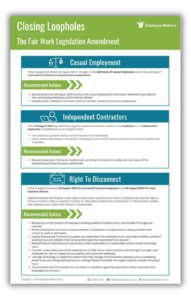
Fair Work Legislation Amendment (Closing Loopholes) Act

Access this concise Closing Loopholes Bill summary and guide detailing the proposed changes to the Fair Work Act, and the implications for employers:

Infographic Closing Loopholes

Need Help?

Outsource your HR & Recruitment to trusted local experts. We help you hire, manage and exit better so you can focus on growing a thriving business.

Get in Touch
Tags: Employee management, Annual Leave
Contents
Where does Australia rank in terms of Paid Parental Leave?
Are Employees being Offered Employer-Paid Parental Leave?
Why Offer Employer-Paid Parental Leave?
What should You Offer in Terms of Employer-Paid Parental Leave?
Here are just four example employer PPL offerings:
Get in Touch

Latest News and Media

Victoria’s Work-From-Home Bill: What Could It Mean for Employers?

  • 10 September 2026
Victoria’s proposed work-from-home changes are putting workplace flexibility back in the spotlight, with employers and employees considering what the changes could mean for the future of work. Employee Matters Managing...
Read More

Ageism in the Workplace: What Australian Businesses Can Learn From easyJet’s Recruitment Drive

  • 1 September 2026
Could Australian businesses be overlooking an experienced and highly capable pool of talent? UK airline easyJet has recently launched another recruitment campaign targeting people aged 50 and over, following an...
Read More

Australia’s Job Mobility Falls to a Record Low: What Does It Mean?

  • 10 August 2026
Australia’s job mobility rate has fallen to its lowest level on record, with fewer Australians choosing to change jobs amid ongoing economic uncertainty. In a shift from the job-hopping trend...
Read More
Should Parents of School-Aged Kids Get Extra Paid Annual Leave

Should Parents of School-Aged Kids Get Extra Paid Annual Leave? – SA Afternoons with Jason Chong | 891 ABC Radio Adelaide

  • 11 July 2026
Have you ever looked at the school calendar and realised the maths just doesn't add up? Working parents face a massive gap between their standard four weeks of annual leave...
Read More

Revealed: The Data Behind Australia’s ‘Great Socceroos Sickie’

  • 1 July 2026
When Australia's World Cup campaign captured the nation's attention, many workplaces experienced something unexpected: a noticeable increase in employee absences. Employee Matters Managing Director Natasha Hawker recently shared her workplace...
Read More

Career Questions People Are Asking AI

  • 29 June 2026
Artificial intelligence is rapidly changing how we work, learn and make decisions but can it really give reliable career advice? Employee Matters Founder and Managing Director, Natasha Hawker, recently joined...
Read More

Sickies, Long Lunches, Green-And-Gold Fever: Australia Set for a Midday Socceroos Party

  • 26 June 2026
Australia’s highly anticipated FIFA World Cup clash against Paraguay lands squarely in the middle of the workday at 12pm Friday AEST. With employers nationwide bracing for a wave of work-from-home...
Read More

When “Office Etiquette” Emails Go Wrong: A Lesson in Workplace Communication

  • 23 June 2026
Navigating sensitive workplace issues is a core part of any manager's job, but a recent incident at a regional organisation serves as a textbook example of poor communication. Following a...
Read More

Latest Blog Articles

The Hidden Mental Health Crisis in Australia: Supporting the ‘Sandwich Generation’

  • 24 August 2026
Employee Matters Managing Director, Natasha Hawker recently shared a powerful LinkedIn post in a moment of vulnerability - it wasn't about a week from hell, it was a snapshot of...
Read More

Why Are Australian Businesses Choosing Embedded Fractional Recruitment Over Traditional Agencies in FY 26-27

  • 20 August 2026
The way Australian businesses are approaching their hiring is changing. For some organisations, paying a recruitment agency a percentage of a candidate’s salary for every hire no longer makes sense,...
Read More

Hidden Risks of Employee Monitoring | What Employers Need to Know

  • 7 August 2026
Employee monitoring has become standard practice for many Australian businesses, particularly since remote and hybrid work arrangements became part of everyday business. Employers may use monitoring tools to protect company data, improve...
Read More

The Power of Purpose: Why an Engaged Workforce is Australia’s Ultimate Competitive Advantage

  • 4 August 2026
There was a time when employee engagement was viewed as a soft HR concept - a warm and fuzzy metric relegated to annual surveys and workplace pizza parties. However, in...
Read More

Strategic Workforce Planning: The Essential Blueprint for Future-Proofing Your Business

  • 27 July 2026
In a rapidly changing business environment, having the right talent in place at the right time is a critical requirement for survival and growth. Many organisations make the mistake of...
Read More

Purpose Over Paychecks: Why a Strong EVP is Your Best Recruitment Tool

  • 22 July 2026
In the current job market, we’re seeing a fascinating shift. It’s no longer just about the digits on a paycheck; it’s about the soul of the company. Recently, our team...
Read More

Accessorial Liability: Why You (Personally) Can’t Afford to “Just Follow Orders”

  • 22 April 2026
In Australian employment law, the "corporate veil" provides little protection for professionals. Under Section 550 of the Fair Work Act 2009, individuals can be held personally liable for company breaches....
Read More

The Redundancy Ripple Effect: Why Unfair Dismissal Claims are Skyrocketing

  • 24 March 2026
In the current Australian economic climate, business as usual feels like a distant memory. As the cost of doing business climbs and the Reserve Bank continues to adjust interest rates,...
Read More

(02) 8021 4206
  • About Us
    • About Employee Matters
    • Book a Free Call
    • What Our Clients Say
  • Services
    • Outsourced HR Services
    • Outsourced Recruitment
    • Recruitment Partner Service (RPS)
  • Resources
    • News and Media
    • Forms & Checklists
    • Blog
  • News and Media
  • Blog
  • Contact Us

Employee Matters helps businesses in Sydney, Melbourne, Perth, Brisbane, and across all major Australian towns and cities with their HR and Recruitment needs.


Home » Implementing Employer-Paid Parental Leave Policies
Copyright | Employee Matters
Terms + Conditions | Privacy Policy
Design by Five by Five