Natasha is a leading HR expert, entrepreneur, author and sought-after media commentator for outlets such as Sunrise (Channel 7), ABC Radio and The Australian Financial Review. Natasha co-founded Employee Matters in 2011 to help Australian businesses achieve success through their people.
Workplace expert Natasha Hawker, Founder and Director of Employee Matters, says family and domestic violence leave is one of the most important but misunderstood workplace entitlements in Australia.
“Managers are not expected to investigate or act as counsellors,” Hawker explains. “Their role is to respond respectfully, ensure the employee understands their options, and connect them with appropriate support, such as an Employee Assistance Program.”
Family and domestic violence (FDV) remains a critical workplace issue in Australia, yet many employees still do not access the entitlements available to them. Despite the introduction of 10 days of paid FDV leave under the Fair Work Act 2009, uptake remains significantly lower than the prevalence of violence experienced across the community.
In Australia, one in four women and one in fourteen men experience family, domestic or sexual violence. For many, the workplace is one of the few stable environments during a period of crisis, yet fear, stigma, and lack of awareness often prevent employees from seeking help.
An Employee Assistance Program (EAP) offers confidential support to strengthen workplace wellbeing. Get the free guide to see why it matters for your organisation
FDV leave is a legislated entitlement designed to support employees experiencing family or domestic violence. It allows individuals to take paid time off work to:
Attend medical or counselling appointments
Access legal or police services
Arrange safe housing or relocation
Manage urgent personal and safety matters
Importantly, this leave is available in full from day one of employment and applies to all employees, including casuals. It is separate from annual or personal leave and does not accrue over time.
Employment lawyer Fay Calderone notes that this entitlement is part of Australia’s National Employment Standards, and non-compliance can carry significant legal consequences for employers.
Why Employees Are Not Accessing FDV Leave
Despite its importance, many employees do not feel safe or informed enough to access FDV leave.
Research by Dr Kantha Dayaram highlights that stigma remains one of the most significant barriers. Employees often fear judgement, job loss, or being labelled as “difficult” if they disclose their situation.
Many also worry about confidentiality, particularly in workplaces where managers are not adequately trained to respond to sensitive disclosures.
In some cases, employees are incorrectly advised to use annual or personal leave instead of their legal entitlement, further discouraging uptake.
The Role of Employers and Managers
Workplace response plays a critical role in whether employees feel safe enough to access support.
Natasha Hawker, Founder and Director of Employee Matters, emphasises that managers are not expected to act as counsellors or investigators.
“Their role is to respond respectfully, ensure the employee understands their options, and connect them with appropriate support — such as an Employee Assistance Program,” says Natasha Hawker.
She also stresses that confidentiality is essential, particularly when it comes to payroll processes.
FDV leave must never be identifiable on payslips or internal systems. Neutral descriptions such as “ordinary hours” or “other paid leave” should be used to avoid exposing employees to risk.
Even small administrative errors can have serious consequences if an employee is living with or being monitored by a perpetrator.
Best Practice When Handling FDV Leave Requests
While employers may legally request evidence for FDV leave, experts advise this should be used sparingly and sensitively.
Fay Calderone explains that leave should be approved promptly, without unnecessary delay or administrative barriers. Requests for documentation such as court orders or medical certificates should only occur where absolutely necessary.
Overly complex processes can discourage employees from accessing support and may increase their risk.
Dr Dayaram’s research also highlights that some employees are still determining their next steps when they first request leave. Requiring immediate proof can deter them entirely.
Building a Safe and Supportive Workplace
Creating a workplace that appropriately supports FDV leave requires more than compliance. It requires culture, training, and trust.
Best practice includes:
Training managers to respond appropriately to disclosures
Ensuring strict confidentiality in HR and payroll systems
Clearly communicating FDV leave entitlements to all staff
Providing access to external support services such as 1800RESPECT
Encouraging a culture where employees feel safe to seek help
Natasha Hawker emphasises that the first conversation matters most. A calm, supportive, and non-judgemental response can significantly influence whether an employee feels safe enough to take the next step.
Family and domestic violence leave is more than an employment entitlement, it is a critical safety mechanism that can help protect employees during some of the most vulnerable moments of their lives.
While legislation provides the framework, workplace culture determines whether people feel safe enough to use it.
Employers who invest in training, confidentiality, and compassionate leadership are not only meeting legal obligations, they are actively supporting employee wellbeing and safety.
Free Infographic Download:
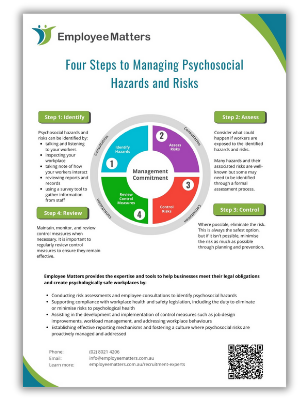
4 Steps to Managing Psychosocial Hazards and Risks
Discover 4 practical steps to identify and control psychosocial hazards before they impact your workplace.
Get in Touch
Tell us a bit about your business and we’ll be in touch to:
Understand the challenges that are holding your team or growth back
Show you how our embedded HR and Recruitment Experts can solve problems faster, without the overheads
Identify high-impact areas where HR and Recruitment support could save you time, stress and money
Map out a tailored approach based on your goals, industry and internal capabilities