



-
Founder and Managing DirectorNatasha is a leading HR expert, entrepreneur, author and sought-after media commentator for outlets such as Sunrise (Channel 7), ABC Radio and The Australian Financial Review. Natasha co-founded Employee Matters in 2011 to help Australian businesses achieve success through their people.
At Employee Matters, we spend a lot of time supporting businesses through difficult conversations. In many cases, those conversations start the same way: “We didn’t think we’d ever need a formal policy for this.”
Misconduct rarely arrives with a warning. It can start small, escalate quickly and leave managers unsure how to respond. A clear misconduct policy gives you a framework to act early, confidently and fairly, without relying on gut feel or improvisation.
Setting Expectations Before Issues Arise
A misconduct policy is not about assuming employees will do the wrong thing. It is about being explicit on what behaviour is expected at work and what happens when those standards are not met.
- When expectations are clearly documented and communicated:
- Employees understand what is acceptable in your workplace
- Managers know when and how to step in
- Conversations are grounded in policy rather than personal opinion
This clarity helps prevent misunderstandings and reduces the likelihood of issues escalating.
Why Informal Approaches Can Create Problems
We often hear that a business prefers to “handle things case by case.” While flexibility is important, the absence of a framework can lead to inconsistent decisions and unnecessary risk.
- Without a documented misconduct disciplinary procedure:
- Similar behaviour may lead to different outcomes
- Employees may feel singled out or treated unfairly
- Managers may delay action due to uncertainty
- Decisions become harder to defend if challenged
A misconduct policy provides a structure that supports fair and reasonable decision-making, while keeping discretion in mind.
Checklist Download:
What Policies Do I Need for Compliance?
Check that you have all the policies required:
Consistency Builds Trust
When misconduct is managed inconsistently, trust is quickly eroded. Employees notice when standards are applied unevenly or when decisions feel reactive.
A well-defined misconduct disciplinary procedure helps ensure that:
- Issues are assessed objectively
- Investigations follow a structured process
- Employees are given procedural fairness
- Outcomes are proportionate to the conduct
Consistency does not mean being rigid but applying the same principles to every situation.
Supporting Managers Through Difficult Conversations
Managing misconduct is one of the most challenging aspects of leadership. Many managers worry about saying the wrong thing, escalating the issue unnecessarily, or exposing the business to risk.
A misconduct disciplinary procedure supports managers by:
- Providing guidance on when informal action is appropriate
- Clarifying when formal steps are required
- Outlining investigation and documentation requirements
- Removing uncertainty around next steps
When managers feel supported by policy, they are more likely to address issues early rather than avoiding them.
Free e-Book Download
7 ER Risks Employers Can’t Afford To Ignore
This e-Book outlines the changes and then highlights 7 risks that failing to act could pose. Enter your name and email to get instant access:
Click Here to Explore More Resources on Australia's Employee Relations Legislation
Protecting Your Business When Decisions Are Challenged
Misconduct issues often escalate when employees feel processes were unfair or rushed. In Australia, unfair dismissal and adverse action claims frequently involve allegations of poor process rather than the conduct itself.
A misconduct policy helps demonstrate that:
- Expectations were communicated in advance
- Employees were given an opportunity to respond
- Decisions were based on evidence
- The process followed a documented procedure
This protection is critical if disciplinary decisions are ever reviewed externally.
Defining Misconduct Clearly Matters
One of the most common issues we see is vague or overly broad wording. Employees and managers alike need clarity around what constitutes misconduct and serious misconduct.
Clear definitions help ensure that:
- Behaviour is assessed appropriately
- Serious matters are escalated correctly
- Disciplinary action is proportionate
- Decisions are easier to explain and justify
Ambiguity creates hesitation. Clarity supports confident action.
The Role of a Clear Misconduct Disciplinary Procedure
A misconduct policy should always be supported by a clear misconduct disciplinary procedure. This is what turns policy into practice.
An effective procedure will typically explain:
- How misconduct concerns are identified or reported
- Investigation steps and expectations
- Employee rights during the process
- How outcomes are determined
- Possible disciplinary actions
Transparency builds confidence, even in difficult situations.
Keeping Your Documents Practical and Current
A misconduct policy should reflect how your workplace actually operates. If it is overly complex or outdated, it is unlikely to be followed.
We recommend reviewing policies regularly to ensure they align with current legislation, organisational values and workplace risks. Just as importantly, policies should be accessible and understood, not filed away and forgotten.
How Employee Matters Can Help
At Employee Matters, we help businesses put workable frameworks in place before issues arise. We don’t believe in generic, one-size-fits-all policies. Your misconduct policy and misconduct disciplinary procedure should reflect how your business operates and the risks you manage day to day.
We work closely with you to review or develop policies that are easy to apply and aligned with your culture. We also support managers in understanding how to use those policies in real situations, so they feel confident having difficult conversations and following the right process.
Want Practical Guidance on Your Misconduct Policy?
Get in touch with us today to update or create a misconduct disciplinary procedure and policy that helps you reduce risks while building trust and confidence:

Australian Employee Relations Legislation Resource Hub
There is a significant amount of mandatory Employment Relations legislative change that impacts you and every other business in Australia now. Our resource hub is designed to help you understand these wide-ranging changes.
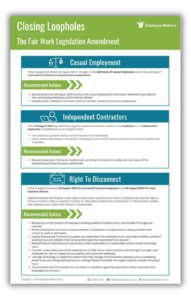
Fair Work Legislation Amendment (Closing Loopholes) Act
Access this concise Closing Loopholes Bill summary and guide detailing the proposed changes to the Fair Work Act, and the implications for employers:

Get in Touch
Tell us a bit about your business and we’ll be in touch to:
- Understand the challenges that are holding your team or growth back
- Show you how our embedded HR and Recruitment Experts can solve problems faster, without the overheads
- Identify high-impact areas where HR and Recruitment support could save you time, stress, and money
- Map out a tailored approach based on your goals, industry, and internal capabilities
Alternatively, you can call us on (02) 8021 4206.

