Subscribe Now

Simply Enter Your Details To Find Out How
We Can Help Your Business


Ready to go on a Discovery?


To Book your Employee Metrics Lite session, please fill in the details below and we will be in contact.

Apply Now

Please fill up the fields below
Employee Matters Logo
Get in Touch Get in Touch (02) 8021 4206
  • HR Services
        • Outsourced HR
        • How We Work - HR
        • Employee Metrics - Data Diagnostics
        • Featured Industries:

        • Australian Startups
        • Finance, Insurance and FinTech
        • Featured Solutions:

        • HR Consulting
        • Workplace Training
        • HR Policies & Procedures
        • Employee Assistance Program (EAP)
        • Products and Packages

        • We deliver measurable results through great HR:

        • Hear What Our Clients Say
  • Recruitment Services
        • Outsourced Recruitment
        • Featured Solutions:

        • Tiered Recruitment Packages
        • Recruitment Partner Service (RPS)
        • Learn More:

        • Hiring Manager Training
        • Why Choose Us for Recruitment?
        • How We Work (RPS)

        • We’re not an agency, and our clients love that:

        • Hear What Our Clients Say
  • About Us
    • About Employee Matters
    • Meet the Team
    • What Our Clients Say
    • Referrals and Partnerships
    • Core Values and Vision
  • Resources
        • The Latest:

        • News and Media
        • Blog Articles
        • Videos and Webinars
        • Featured Content:

        • ER Legislation Resource Hub
        • e-Book: 7 ER Risks for Employers
        • Downloads and Knowledge Hub:

        • HR Forms & Checklists
        • 'Working From Home' Pack
        • HR & Recruitment FAQ’s
        • Book: "From Hire to Fire"
        • From the Archives:

        • 'Employees Matter' Podcast
  • Jobs
  • Contact Us

Get Ready for the Employment Law Changes Happening in August 2024

Home » Get Ready for the Employment Law Changes Happening in August 2024

July 25, 2024
  • Natasha Hawker HR recruitment expert
    Written by Natasha Hawker
    Founder and Managing Director

    Natasha is a leading HR expert, entrepreneur, author and sought-after media commentator for outlets such as Sunrise (Channel 7), ABC Radio and The Australian Financial Review. Natasha co-founded Employee Matters in 2011 to help Australian businesses achieve success through their people.

By David Brown, General Manager

Cast your mind back to February this year and all the media reports around the Closing Loopholes (no. 2) Bill which included changes such as:

  • The Right to Disconnect
  • Changes to Casual Employment
  • The New Definition of an Employee
  • Changes to Independent Contractor Rules and Definitions

You may not have heard too much since then, but all of these changes are due to take effect from 26 August 2024.

(Note: for small businesses of less than 15 employees, some of these rules and timelines are slightly different).

Let’s take a look then at a brief summary of the changes you need to be aware of and ready for in August 2024.

The Right to Disconnect

This new rule allows employees to refuse to monitor and/or respond to any work-related contact outside of their normal working hours, e.g. calls, texts, messages and emails.

There are a number of exceptions to this rule, the most important being if such a refusal would be ‘unreasonable.’ As always, what is reasonable will be a matter for interpretation and we will see a clearer picture as cases make their way to the courts, but we already have indications of what will and will not be reasonable. For example:

  • Is the employee compensated, e.g. an on-call allowance?
  • Is the employee a senior manager, where it would be more reasonable to contact them out of hours?
  • Is there a reasonable purpose behind the contact, e.g. an emergency or requesting that the employee change their next shift?
  • Will the contact cause unreasonable disruption to the employee, taking into account their personal circumstances, e.g. if they have carer responsibilities?

Things to Think About

When considering how to manage your new obligations, think about the following:

  • Do you need to change any policies or processes around, for example, out-of-hours work, flexible working or on-call policies?
  • Can you use technology to schedule communications, e.g. delayed or scheduled send options in your email or messaging systems?
  • Have you made your managers aware of the new rules?

Employee Matters is here to advise you on how best to manage this new right in your organisation. Book a free call now to learn how we can help you implement this and other recent changes.

Casual Employment

Everything old is new again, as the saying goes, and this is especially true in terms of definitions of who IS and who IS NOT a casual employee. The new definition of WHO IS a casual employee is essentially a step back in time to a few years ago, before the High Court rulings in the ‘Workpac Cases.’

For the last three years or so, organisations have been able to rely on the fact that if your contract clearly states someone is a casual employee, then the law will see them as a casual employee. From August 2024, we are going back to a similar definition to that existing pre-Workpac, which is that you must look at the entirety of the working relationship to determine if in fact an employee is casual or permanent, i.e. what is the practical reality of the arrangement around whether there is a firm advanced commitment to provide work?

So it's time to once again look at your relationships with your casuals and make a judgement on this.

There has also been a change in how an employee would claim they are permanent rather than casual. Currently, you as the employer are bound to ask the casual if they wish to consider converting to permanent. From August 2024, the employee will need to approach their employer to request they be reclassified. Should they do this, there are obligations on the employer to consider the request, limits on when they can refuse the request, and obligations to consult and make a written reply to the employee with their reasons for refusal.

Lastly, there are changes in employers’ obligations to issue the Casual Employee information Statement. Currently, this must be issued to a casual employee when they commence employment. This will now change with requirements to issue: at commencement; after six months; after 12 months and every 12 months thereafter (the rules are less stringent for small businesses).

Things to Think About

  • Consider your working relationships with all casuals and make a judgement on whether they meet the (more vague) test of whether they are truly casual. Consider shift patterns, how far in advance you plan your rosters, the regularity of the work and, the ability of the employee to refuse a shift.
  • Think about the process you would follow if an employee claims they are permanent. How will you handle this, how will you communicate with the employee and how will you respond?
  • Have you prepared your administration process and systems to meet your obligation around providing the casual employment information statement more regularly?

Again Employee Matters would be happy to discuss this with you should you have any questions. You can call us now on (02) 8021 4206.

Independent Contractors

As with casuals, we are seeing a change back to a more wide-ranging definition of who is an independent contractor.

With the inclusion of a definition of an employee in the Fair Work Act for the first time, the definition of who is not an employee has to be made on the same basis, looking at “the real substance, practical reality and true nature of the relationship.” The courts will look at the contract as they have before, but the contract will no longer be the sole, or even primary, evidence as to whether someone is a contractor or an employee. The facts of the case may include, among other things:

  • does the worker wear a company uniform?
  • do they supply their own equipment?
  • do they have more autonomy in terms of how the work is done?
  • can they subcontract the work to someone else?
  • does the employer have other people doing similar work who are classed as employees?

Opt Out

A new opt-out provision is included for high-earning contractors who may choose to opt out of this definition and class themselves as a contractor regardless of the circumstances above. Strangely, although the opt-out has been in place since February 2024, the definition of ‘high income’ does not come into force until 26 August 2024 and we have still not been told what that high Income threshold will be.

Note also that the contractor is allowed to give an employee notice to change their mind and decide they no longer wish to opt out of the definition.

Summary

There are more changes that have come in and more changes still to be enacted.

  • Changes to unfair contract terms which will affect organisations using ‘Gig Workers’ for instance (from August 2024)
  • Introduction of industrial manslaughter as a criminal offence (from 1 July 2024)
  • Introduction of criminal offences around wage theft (from 1 January 2025)

The areas discussed above are issues you need to be planning for right now.

For more information on your new obligations, contact us now to request a consultation on what you need to do to remain compliant.


Australian Employee Relations Legislation Resource Hub

There is a significant amount of mandatory Employment Relations legislative change that impacts you and every other business in Australia now. Our resource hub is designed to help you understand these wide-ranging changes.


Access It Here

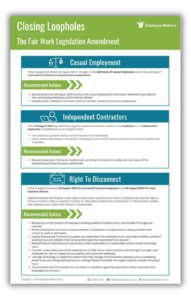
Fair Work Legislation Amendment (Closing Loopholes) Act

Access this concise Closing Loopholes Bill summary and guide detailing the proposed changes to the Fair Work Act, and the implications for employers:

Infographic Closing Loopholes

Get in Touch

Tell us a bit about your business and we’ll be in touch to:

  • Understand the challenges that are holding your team or growth back
  • Show you how our embedded HR and Recruitment Experts can solve problems faster, without the overheads
  • Identify high-impact areas where HR and Recruitment support could save you time, stress, and money
  • Map out a tailored approach based on your goals, industry, and internal capabilities

Alternatively, you can call us on (02) 8021 4206.

Tags: Startups, Human Resource
Contents
The Right to Disconnect
Casual Employment
Independent Contractors
Opt Out
Summary
Get in Touch

Latest News and Media

Revealed: The Data Behind Australia’s ‘Great Socceroos Sickie’

  • 1 July 2026
When Australia's World Cup campaign captured the nation's attention, many workplaces experienced something unexpected: a noticeable increase in employee absences. Employee Matters Managing Director Natasha Hawker recently shared her workplace...
Read More

Career Questions People Are Asking AI

  • 29 June 2026
Artificial intelligence is rapidly changing how we work, learn and make decisions but can it really give reliable career advice? Employee Matters Founder and Managing Director, Natasha Hawker, recently joined...
Read More

Sickies, Long Lunches, Green-And-Gold Fever: Australia Set for a Midday Socceroos Party

  • 26 June 2026
Australia’s highly anticipated FIFA World Cup clash against Paraguay lands squarely in the middle of the workday at 12pm Friday AEST. With employers nationwide bracing for a wave of work-from-home...
Read More

When “Office Etiquette” Emails Go Wrong: A Lesson in Workplace Communication

  • 23 June 2026
Navigating sensitive workplace issues is a core part of any manager's job, but a recent incident at a regional organisation serves as a textbook example of poor communication. Following a...
Read More
NSW Drive with Jess McGuire - ABC listen

The Hidden Cost of Office Gossip: Navigating Australia’s New Psychosocial Hazard Laws

  • 23 June 2026
We have all seen it happen: a quiet whisper in the tea room or a cryptic text message. While often viewed as harmless chit-chat, office gossip is now a serious...
Read More

Family and Domestic Violence Leave Australia: Rights, Entitlements and Employer Obligations

  • 11 June 2026
Workplace expert Natasha Hawker, Founder and Director of Employee Matters, says family and domestic violence leave is one of the most important but misunderstood workplace entitlements in Australia. “Managers are...
Read More

AI ‘Brain Fry’ and the Rise of Psychosocial Claims in Australian Workplaces

  • 2 June 2026
Employee Matters Managing Director Natasha Hawker recently joined Channel 7's Sunrise to discuss a growing workplace concern: the impact of AI on employee wellbeing and the rise of psychosocial risks...
Read More

Webinar: Why Most Businesses Get Hiring Wrong (and what to do instead)

  • 27 May 2026
Hiring isn’t just about filling a seat; it’s about bringing the right person into your business. Yet, too many businesses rely on outdated methods, rush the process, or put blind...
Read More

Latest Blog Articles

Accessorial Liability: Why You (Personally) Can’t Afford to “Just Follow Orders”

  • 22 April 2026
In Australian employment law, the "corporate veil" provides little protection for professionals. Under Section 550 of the Fair Work Act 2009, individuals can be held personally liable for company breaches....
Read More

The Redundancy Ripple Effect: Why Unfair Dismissal Claims are Skyrocketing

  • 24 March 2026
In the current Australian economic climate, business as usual feels like a distant memory. As the cost of doing business climbs and the Reserve Bank continues to adjust interest rates,...
Read More

Beyond the Request: Victoria’s New Era of Right to WFH

  • 16 March 2026
The conversation around flexible work in Australia is shifting from asking for a favour to exercising a legal right. While recent Fair Work Commission rulings like Fitzpatrick v UNSW and...
Read More

A Tale of Two WFH Requests

  • 16 March 2026
Recent rulings in the Fair Work Commission have provided a critical wakeup call for both employees and HR professionals. Two landmark cases from 2025 and 2026 (Fitzpatrick v University of...
Read More

Leading the Way: Sentius Implements Groundbreaking Menstrual and Menopause Policy

  • 9 March 2026
At Employee Matters, we are incredibly proud to partner with clients who don't just talk about workplace culture but actively build it. Today, we are celebrating a major milestone with...
Read More
Workplace misconduct policy guide

Why Every Business Needs a Clear Misconduct Policy

  • 26 February 2026
At Employee Matters, we spend a lot of time supporting businesses through difficult conversations. In many cases, those conversations start the same way: “We didn’t think we’d ever need a...
Read More
Benefits of outsourced HR services

How Outsourced HR Services Can Save You Time, Money and Stress

  • 24 February 2026
Most business owners don’t start a company because they’re passionate about employment contracts, performance plans, or award interpretations. Yet, before long, HR becomes a regular part of the working week....
Read More
HR blog header banner

Scrolling to Success: How to Recruit and Retain Generation Z

  • 16 February 2026
The Australian workforce is undergoing a seismic shift. As Baby Boomers retire and Millennials move into senior leadership, a new force has risen: Generation Z. Born between 1997 and 2012,...
Read More

(02) 8021 4206
  • About Us
    • About Employee Matters
    • Book a Free Call
    • What Our Clients Say
  • Services
    • Outsourced HR Services
    • Outsourced Recruitment
    • Recruitment Partner Service (RPS)
  • Resources
    • News and Media
    • Forms & Checklists
    • Blog
  • News and Media
  • Blog
  • Contact Us

Employee Matters helps businesses in Sydney, Melbourne, Perth, Brisbane, and across all major Australian towns and cities with their HR and Recruitment needs.


Home » Get Ready for the Employment Law Changes Happening in August 2024
Copyright | Employee Matters
Terms + Conditions | Privacy Policy
Design by Five by Five