Subscribe Now

Simply Enter Your Details To Find Out How
We Can Help Your Business


Ready to go on a Discovery?


To Book your Employee Metrics Lite session, please fill in the details below and we will be in contact.

Apply Now

Please fill up the fields below
Employee Matters Logo
Get in Touch Get in Touch (02) 8021 4206
  • HR Services
        • Outsourced HR
        • How We Work - HR
        • Employee Metrics - Data Diagnostics
        • Featured Industries:

        • Australian Startups
        • Finance, Insurance and FinTech
        • Featured Solutions:

        • HR Consulting
        • Workplace Training
        • HR Policies & Procedures
        • Employee Assistance Program (EAP)
        • Products and Packages

        • We deliver measurable results through great HR:

        • Hear What Our Clients Say
  • HRIS
    • EmployeeHub – Managed HRIS (HR Information System)
  • Recruitment Services
        • Outsourced Recruitment
        • Featured Solutions:

        • Tiered Recruitment Packages
        • Recruitment Partner Service (RPS)
        • Learn More:

        • Hiring Manager Training
        • Why Choose Us for Recruitment?
        • How We Work (RPS)

        • We’re not an agency, and our clients love that:

        • Hear What Our Clients Say
  • About Us
    • About Employee Matters
    • Meet the Team
    • What Our Clients Say
    • Referrals and Partnerships
    • Core Values and Vision
  • Resources
        • The Latest:

        • News and Media
        • Blog Articles
        • Videos and Webinars
        • Featured Content:

        • ER Legislation Resource Hub
        • e-Book: 7 ER Risks for Employers
        • Downloads and Knowledge Hub:

        • HR Forms & Checklists
        • 'Working From Home' Pack
        • HR & Recruitment FAQ’s
        • Book: "From Hire to Fire"
        • From the Archives:

        • 'Employees Matter' Podcast
  • Jobs
  • Contact Us

The Hidden Cost of Sexual Harassment

Home » The Hidden Cost of Sexual Harassment

October 6, 2025
  • Caroline Ross HR recruitment expert
    Written by Caroline Ross
    Systems & Marketing Expert

    Caroline has 13 years of experience as a Recruitment professional, as well as a wide-ranging global career that included 10 years in logistics for the United Nations. Caroline’s deep knowledge of Employee Matters’ HR and Recruitment solutions and internal systems makes her instrumental in supporting our team of Experts to deliver high-quality client experiences.

While sexual harassment is a profound violation of an individual's rights and wellbeing, its impact extends far beyond the personal harm to the victim; it carries a significant and often hidden financial burden for Australian businesses, a cost that can be measured in billions of dollars and far reaching damage to a company's reputation and bottom line, more on that to follow.

Free Infographic Download:

Workplace Sexual Harassment is Bad for Business

See how workplace sexual harassment can harm business reputation and employee productivity. Find out what the data reveals about its true cost to Australian workplaces.

The Dollars and Cents of Disrespect

The financial repercussions of sexual harassment are a serious issue for business. The cost manifests itself in various ways, impacting productivity and increasing operational expenses.

  • Decreased Productivity: When employees feel unsafe or uncomfortable, their focus and efficiency suffer. The cost of decreased productivity from sexual harassment was an estimated $3.8 billion for businesses in 2018.
  • Increased Absenteeism and Staff Turnover: Sexual harassment can lead to disengaged employees, increased absenteeism and a higher rate of staff turnover. High turnover means businesses spend more on recruitment, onboarding and training new employees. A recent survey found that a significant number of employees would consider leaving a job that did not take sexual harassment seriously.
  • Legal and Workers' Compensation Costs: Businesses face significant legal costs for representation and court proceedings, as well as potential compensation payments to victims. Damages can include lost earnings, pain and suffering, aggravated damages and workers’ compensation claims. The cost of claims can also increase insurance premiums. In a recent case, the Federal Court awarded a record-breaking $305,000 in damages to a worker who suffered psychological injury due to a "toxic and harassment filled workplace culture".
  • Reputational Damage: Incidents of harassment can damage a company's reputation, both internally and externally. This can result in a loss of trust among employees and customers and can even impact a company's share market value.

Checklist Download:

What To if an Employee Claims That They Are Being Sexually Harassed

Steps to take with a sexual harassment claim

Download Asset Here

Respect@Work: A New Approach for Employers

The landmark Respect@Work report released in 2020 by the Australian Human Rights Commission, called for a fundamental shift in how workplaces address sexual harassment. It proposed a new, proactive approach that moves away from a complaints-based model to one that requires employers to take positive action to prevent harassment from occurring in the first place. The report's 55 recommendations are a roadmap for this change.

The most significant change is the introduction of a positive duty in the Sex Discrimination Act 1984. This legal obligation requires employers to take "reasonable and proportionate measures" to eliminate sexual harassment and other forms of unlawful sex discrimination as far as possible. Since December 2023, the Australian Human Rights Commission has been empowered to monitor and enforce this positive duty, including through investigations, compliance notices and enforceable undertakings.

In addition, the Fair Work Act 2009 (Cth) now expressly prohibits sexual harassment at work. Employees can apply to the Fair Work Commission for Stop Sexual Harassment Orders and also seek remedies including compensation.

Employers must also remember their duties under state and territory Work Health and Safety laws. Sexual harassment is recognised as a psychosocial hazard and employers have a duty of care to eliminate or minimise these risks as far as reasonably practicable. Safe Work Australia’s Code of Practice on Managing Psychosocial Hazards (2022) provides clear guidance on these obligations.

It is no longer enough to simply have a policy in the employee handbook; employers must take active steps to foster a culture that prevents this behaviour.

Free Infographic Download:

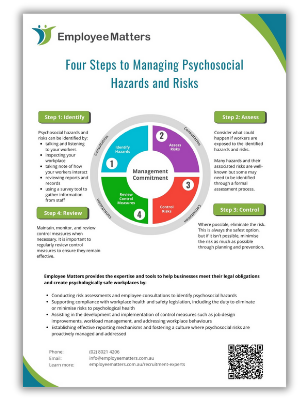
4 Steps to Managing Psychosocial Hazards and Risks

Discover 4 practical steps to identify and control psychosocial hazards before they impact your workplace.

Practical Steps to Meet the Positive Duty of Care

Compliance and cultural change must be embedded into the business DNA, from day one of employment to ongoing development.

  • Respect@Work Training: Implement mandatory, regular and scenario-based Respect@Work training for all staff. This training shouldn't just cover the legal definitions but must also focus on bystander intervention and managerial obligations to report and respond appropriately. Refresher training should be provided annually to reinforce knowledge and commitment to cultural standards.
  • Onboarding of New Team Members: Sexual harassment and behaviour policies must be an essential component of onboarding of new team members. This signals immediately that safety and respect are non-negotiable cultural standards. Ideally, new hires should sign a formal acknowledgement that they have read and understood the anti harassment policy and the expectations under the positive duty.
  • Cultural Change Resources Available Internally: Prevention requires constant reinforcement. Ensure cultural change resources are available internally, such as accessible policy documents, contact information for internal and external support services (like an Employee Assistance Program) and clear flowcharts on how to report an incident. These resources should be promoted consistently through internal communication channels to ensure they are top-of-mind.
  • Adopt a Victim Centred Approach: Ensure anyone who reports harassing behaviour is heard and supported empathetically and that all steps are taken to prevent re-victimisation. The process must be trauma-informed and focus on reducing further harm.
  • Monitor, Evaluate and Be Transparent: Regularly gather data (including anonymous feedback) to assess your workplace culture and the effectiveness of your preventative measures. You can't fix what you don't measure.

Take the First Step in Supporting Your Employees

An Employee Assistance Program (EAP) offers confidential support to strengthen workplace wellbeing. Get the free guide to see why it matters for your organisation

Learn More About EAP

The Australian Human Rights Commission has created a range of resources to help employers and workers implement the Respect@Work recommendations, including best-practice guides, training materials and workplace-assessment tools.

Sexual harassment is not just a moral or legal issue; it's a critical business risk. It is now also a clear legal compliance obligation under the Sex Discrimination Act, Fair Work Act and Work Health and Safety legislation. By proactively embracing the guidelines of the Respect@Work report, Australian businesses can not only protect their employees but also their bottom line, fostering a safer, more productive and ultimately more successful workplace for everyone.

Need help with implementing any elements of Respect@Work, employee training or development of policies in your workplace?

Call us at (02) 8021 4206 or email us at info@employeematters.com.au.

You may also be interested in: 

  • How We Work 
  • What our Clients Say

Get in Touch

Tell us a bit about your business and we’ll be in touch to:

  • Understand the challenges that are holding your team or growth back
  • Show you how our embedded HR and Recruitment Experts can solve problems faster, without the overheads
  • Identify high-impact areas where HR and Recruitment support could save you time, stress and money
  • Map out a tailored approach based on your goals, industry and internal capabilities

Alternatively, you can call us on (02) 8021 4206.

Tags: Employee management, Legislation, Health and safety, Management
Contents
The Dollars and Cents of Disrespect
Respect@Work: A New Approach for Employers
Practical Steps to Meet the Positive Duty of Care
Get in Touch

Latest News and Media

Should Parents of School-Aged Kids Get Extra Paid Annual Leave

Should Parents of School-Aged Kids Get Extra Paid Annual Leave? – SA Afternoons with Jason Chong | 891 ABC Radio Adelaide

  • 11 July 2026
Have you ever looked at the school calendar and realised the maths just doesn't add up? Working parents face a massive gap between their standard four weeks of annual leave...
Read More

Revealed: The Data Behind Australia’s ‘Great Socceroos Sickie’

  • 1 July 2026
When Australia's World Cup campaign captured the nation's attention, many workplaces experienced something unexpected: a noticeable increase in employee absences. Employee Matters Managing Director Natasha Hawker recently shared her workplace...
Read More

Career Questions People Are Asking AI

  • 29 June 2026
Artificial intelligence is rapidly changing how we work, learn and make decisions but can it really give reliable career advice? Employee Matters Founder and Managing Director, Natasha Hawker, recently joined...
Read More

Sickies, Long Lunches, Green-And-Gold Fever: Australia Set for a Midday Socceroos Party

  • 26 June 2026
Australia’s highly anticipated FIFA World Cup clash against Paraguay lands squarely in the middle of the workday at 12pm Friday AEST. With employers nationwide bracing for a wave of work-from-home...
Read More

When “Office Etiquette” Emails Go Wrong: A Lesson in Workplace Communication

  • 23 June 2026
Navigating sensitive workplace issues is a core part of any manager's job, but a recent incident at a regional organisation serves as a textbook example of poor communication. Following a...
Read More
NSW Drive with Jess McGuire - ABC listen

The Hidden Cost of Office Gossip: Navigating Australia’s New Psychosocial Hazard Laws

  • 23 June 2026
We have all seen it happen: a quiet whisper in the tea room or a cryptic text message. While often viewed as harmless chit-chat, office gossip is now a serious...
Read More

Family and Domestic Violence Leave Australia: Rights, Entitlements and Employer Obligations

  • 11 June 2026
Workplace expert Natasha Hawker, Founder and Director of Employee Matters, says family and domestic violence leave is one of the most important but misunderstood workplace entitlements in Australia. “Managers are...
Read More

AI ‘Brain Fry’ and the Rise of Psychosocial Claims in Australian Workplaces

  • 2 June 2026
Employee Matters Managing Director Natasha Hawker recently joined Channel 7's Sunrise to discuss a growing workplace concern: the impact of AI on employee wellbeing and the rise of psychosocial risks...
Read More

Latest Blog Articles

Strategic Workforce Planning: The Essential Blueprint for Future-Proofing Your Business

  • 27 July 2026
In a rapidly changing business environment, having the right talent in place at the right time is a critical requirement for survival and growth. Many organisations make the mistake of...
Read More

Purpose Over Paychecks: Why a Strong EVP is Your Best Recruitment Tool

  • 22 July 2026
In the current job market, we’re seeing a fascinating shift. It’s no longer just about the digits on a paycheck; it’s about the soul of the company. Recently, our team...
Read More

Accessorial Liability: Why You (Personally) Can’t Afford to “Just Follow Orders”

  • 22 April 2026
In Australian employment law, the "corporate veil" provides little protection for professionals. Under Section 550 of the Fair Work Act 2009, individuals can be held personally liable for company breaches....
Read More

The Redundancy Ripple Effect: Why Unfair Dismissal Claims are Skyrocketing

  • 24 March 2026
In the current Australian economic climate, business as usual feels like a distant memory. As the cost of doing business climbs and the Reserve Bank continues to adjust interest rates,...
Read More

Beyond the Request: Victoria’s New Era of Right to WFH

  • 16 March 2026
The conversation around flexible work in Australia is shifting from asking for a favour to exercising a legal right. While recent Fair Work Commission rulings like Fitzpatrick v UNSW and...
Read More

A Tale of Two WFH Requests

  • 16 March 2026
Recent rulings in the Fair Work Commission have provided a critical wakeup call for both employees and HR professionals. Two landmark cases from 2025 and 2026 (Fitzpatrick v University of...
Read More

Leading the Way: Sentius Implements Groundbreaking Menstrual and Menopause Policy

  • 9 March 2026
At Employee Matters, we are incredibly proud to partner with clients who don't just talk about workplace culture but actively build it. Today, we are celebrating a major milestone with...
Read More
Workplace misconduct policy guide

Why Every Business Needs a Clear Misconduct Policy

  • 26 February 2026
At Employee Matters, we spend a lot of time supporting businesses through difficult conversations. In many cases, those conversations start the same way: “We didn’t think we’d ever need a...
Read More

(02) 8021 4206
  • About Us
    • About Employee Matters
    • Book a Free Call
    • What Our Clients Say
  • Services
    • Outsourced HR Services
    • Outsourced Recruitment
    • Recruitment Partner Service (RPS)
  • Resources
    • News and Media
    • Forms & Checklists
    • Blog
  • News and Media
  • Blog
  • Contact Us

Employee Matters helps businesses in Sydney, Melbourne, Perth, Brisbane, and across all major Australian towns and cities with their HR and Recruitment needs.


Home » The Hidden Cost of Sexual Harassment
Copyright | Employee Matters
Terms + Conditions | Privacy Policy
Design by Five by Five