David has over 30 years of experience in Human Resources and operational management. David blends his deep HR expertise and business experience to help our clients achieve profitability and clarity through their people strategy, while also creating the internal structures that ensure Employee Matters’ own sustainable growth.
Exit interviews are a valuable tool for organisations in Australia, BUT here is the key, only when they are used properly. How many times have you:
Held an exit interview and then just ‘filed it’ afterwards?
Participated in an exit interview with no confidence anyone would bother taking notice of it afterwards?
If done well, exit interviews provide a valuable opportunity to gain insights into employee satisfaction, company culture and potential areas for improvement, identifying issues that may be hindering productivity & retention and giving organisations the opportunity to take steps to address the issues.
Let’s take a detailed look at the benefits of exit interviews and tips for making the most of them.
Why Conduct Exit Interviews?
Exit interviews provide an unique opportunity to gain perspectives on your organisation that you may struggle to receive at any other point in the employee lifecycle.
For many employees, this is the point where they have least to lose in being open and honest with the organisation: they are about to leave, usually with either another job or exciting life opportunity lined up. As such, you may find them much more forthcoming with a ‘warts and all’ review of:
What's great in the organisation,
What's not great,
What challenges employees face that you may know nothing about, and
How the real culture and values of the organisation match up to your stated culture and values.
Specifically, think about the exit interview as your opportunity to:
Identify Reasons for Leaving: Understanding why employees choose to leave can help pinpoint areas of dissatisfaction or frustration.
Assess Company Culture: Exit interviews can reveal insights into the company's work environment, management style and overall culture.
Improve Employee Retention: By addressing issues raised in exit interviews, businesses can take steps to improve employee satisfaction and reduce turnover.
Enhance Recruitment and Selection: Analysing the reasons for employee departures can help refine the recruitment & selection process to attract and retain top talent.
Create Brand Advocates: A positive exit interview is great for ensuring a happy exit for the employee who can continue to advocate for the organisation after they have left.
What Are the Key Questions to Ask in an Exit Interview?
While the specific questions will vary depending on the the needs of the organisation, here are some questions you should consider including: 1. Reasons for Leaving:
What was the primary reason for your decision to leave?
Were there any specific events or circumstances that led to your decision?
Were there any factors that could have influenced you to stay?
If you are going to another job:
Is it a promotion or the same role elsewhere?
Who is your new employer?
2. Job Satisfaction:
How satisfied were you with your role and responsibilities?
Were your expectations met regarding workload, challenges, and opportunities for growth?
Did you feel valued and recognised for your contributions?
3. Management and Leadership:
How would you rate your relationship with your immediate supervisor?
Did you feel supported and encouraged by your manager?
Were there any instances of poor management or leadership that impacted your experience?
4. Company Culture:
How would you describe the company culture?
Did you feel a sense of belonging and connection to the team?
Were there any aspects of the company culture that you found positive or negative?
5. Work-Life Balance:
How satisfied were you with your work-life balance?
Did you feel that the company supported your personal and professional goals?
Were there any specific work-life balance issues that impacted your decision to leave?
6. Training and Development:
Did you receive adequate training and development opportunities?
Were there any skills or knowledge gaps that were not addressed?
Did you feel that the company invested in your professional growth?
7. Compensation and Benefits:
Were you satisfied with your compensation & benefits package?
Did you feel that your compensation was fair and competitive?
Were there any specific issues with compensation or benefits that contributed to your decision to leave?
Want to Improve Your Offboarding Process?
Get Expert HR Advice.
The key, which is often overlooked in designing an exit interview format, is to start with the end in mind. Ask yourself, how are you going to make the most use out of the data you collect?
Think about this in terms of covering two use case scenarios:
What specific issues are raised in this interview that may demand the attention of the organisation? For example, has the departing employee raised something specific in terms of the culture and behaviours in your organisation that require further investigation or action?
How does the information you gather from this exit interview feed into your ability to analyse more general trends in the organisation?
Taking these two scenarios into account, what are the implications for the design of your exit interview process? Here are some things to consider:
Confidentiality: Can you assure the employee of complete confidentiality? This can be difficult in the most extreme cases (e.g. you are alerted to possible illegality in the organisation). However you can offer:
Confidentiality where this is not the case
Anonymity as an alternative (i.e. you will report the issue but will not say whose exit interview was the source of the information)
A choice of either or both for specific questions in the exit interview
Format: Should the exit interview be more akin to an online survey or should it be a face-to-face interview? Online surveys are easier and less time consuming, but you are unlikely to get the same quality of response as you would with a face-to-face meeting (even if it is via a video call).
Interviewer: Who should conduct an exit interview? Ideally, the interviewer would be someone removed from the employee (e.g. HR department or external consultant) rather than the line manager who may be seen to have a vested interest in the answers and may mean the employee is not as forthcoming.
Data: Aim for a mix of data types - quantitative and qualitative. Quantitative data (e.g. numerical rating) is easier to use in determining trends. Qualitative data (e.g. open questions and recording what the employee says) gives more colour to the data and helps with identifying specific issues.
Data recording: Many organisations use a simple form in a Microsoft Word document to record responses. Consider instead using a survey tool such as Google Forms, Survey Monkey or tools built into HR Information Systems (HRIS) which allow you to store data both individually and in aggregate. Importantly, it is then all in one place which makes analysis much more simple
Free Download:
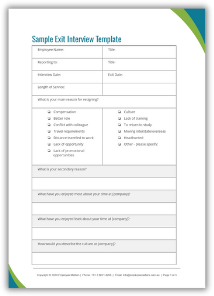
Sample Exit Interview Template
Make your offboarding process smoother and more effective with this ready-to-use Exit Interview Template
Tips for Conducting Effective Exit Interviews
Create a Safe and Confidential Environment: Ensure that employees feel comfortable sharing their honest feedback.
Active Listening: Pay close attention to what the employee is saying and ask clarifying questions.
Avoid Defensiveness: Stay calm and composed, even if the feedback is negative.
Take Notes: Document key points of the conversation to refer to later (see the point above on using survey tools).
Follow Up: Thank the employee for their time and feedback, and let them know that their input is valued.
Analyse and Implement Changes: Don’t just check for significant issues before filing the interview record never to be read again. Regularly review the feedback from your exit interviews and identify areas for improvement.
Checklist Download:
What Do I Do If An Employee Is Not Performing?
Practical steps to address and improve employee performance:
By conducting effective exit interviews, you can gain valuable insights into your workforce and take steps to improve employee satisfaction, retention and overall performance.
Employee Matters can advise on best-practice exit interviews, as well as acting as an independent third party to ensure you get the most in-depth and honest feedback possible from your exit interview process:
Get in Touch
Tell us a bit about your business and we’ll be in touch to:
Understand the challenges that are holding your team or growth back
Show you how our embedded HR and Recruitment Experts can solve problems faster, without the overheads
Identify high-impact areas where HR and Recruitment support could save you time, stress and money
Map out a tailored approach based on your goals, industry and internal capabilities
Scaling Impact on a Nonprofit Budget: How Asthma Australia Found the Perfect HR Partner
Operating as a resource-lean organisation, Asthma Australia needs to ensure all functions are efficient and effective. The organisation was looking for a HR business partner to support the critical need for expertise to secure key talent and bolster their overall HR infrastructure with compliance as a focus.